Service Discovery
When you have many microservices, one big question arises:
How do clients find a microservice and its available instances?
The Problem
Microservices often run in containers, and each container may get a dynamic IP address when it starts. This makes it tricky for clients to know where to send requests.
For example, imagine you have a User Service that exposes an HTTP API. Every time it restarts, it may get a new IP like 10.0.1.15 or 10.0.1.20. How will the client know the correct address?
Without a solution, requests may fail or go to the wrong instance.
The Solution
We introduce a Service Discovery Service — a special component that keeps track of all available microservices and their current addresses.
With service discovery:
- Microservices register themselves when they start.
- Microservices unregister when they stop or fail.
- Clients can use a logical name (like UserService) instead of IP addresses.
- Requests are automatically load-balanced across multiple instances.
- Unhealthy instances are detected and excluded from requests.
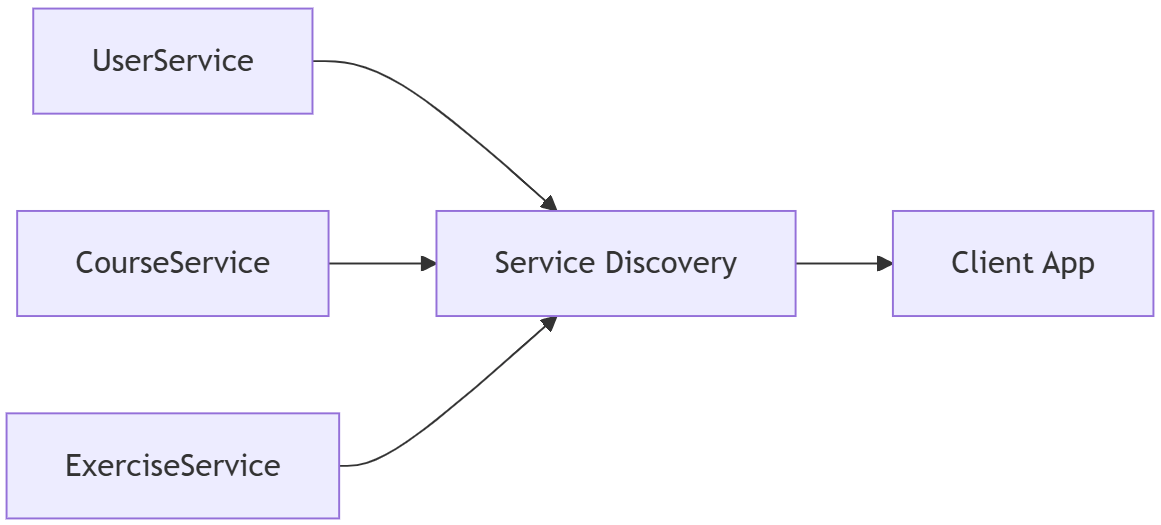
- Each service registers with the Service Discovery.
- The client app doesn’t need to know IPs. It just asks for UserService, ExerciseService or CourseService.
- Requests are load-balanced among multiple instances.
- If an instance fails, it is automatically ignored.
Implementation Approaches
There are two main strategies:
- Client-Side Routing
- The client itself queries the service discovery service to find the right instance.
- The client decides which instance to call.
- Example: A web app calls the ExerciseService. The client asks the service registry: “Which IP is available?” and sends the request there.
- Server-Side Routing
- The service discovery infrastructure includes a reverse proxy.
- Clients always send requests to the proxy, which forwards them to the correct instance.
- Example: A mobile app requests NotificationService. The proxy automatically picks a healthy instance and routes the request.
Key Points to Remember
- Service discovery solves the dynamic IP problem in microservices.
- It enables scaling: multiple instances can run, and clients are routed to them automatically.
- You can implement it with client-side or server-side routing, depending on your architecture.
- Popular tools include Netflix Eureka, Consul, and Kubernetes services.