Understanding Locks
When I first started learning about databases, I thought there were only two types of locks: shared and exclusive.
- A shared lock (or read lock) allows multiple sessions to read the same data at the same time.
- An exclusive lock (or write lock) ensures that only one session can modify data — all others must wait.
It seemed simple at first, but as I explored PostgreSQL, I realized the reality is much more nuanced. PostgreSQL provides five main categories of locks and over a dozen specific lock types, each serving a distinct purpose. Understanding them is crucial for writing safe and efficient applications.
Here’s an overview:
- Row-level Locks – Protect individual rows in a table.
- Table-level Locks – Protect entire tables.
- Tuple Locks (Row Version Locks) – Used internally by PostgreSQL’s MVCC system.
- Advisory Locks – Application-controlled locks, independent of MVCC.
- Other Internal Locks – Used internally for specific system operations (e.g., sequences, caches).
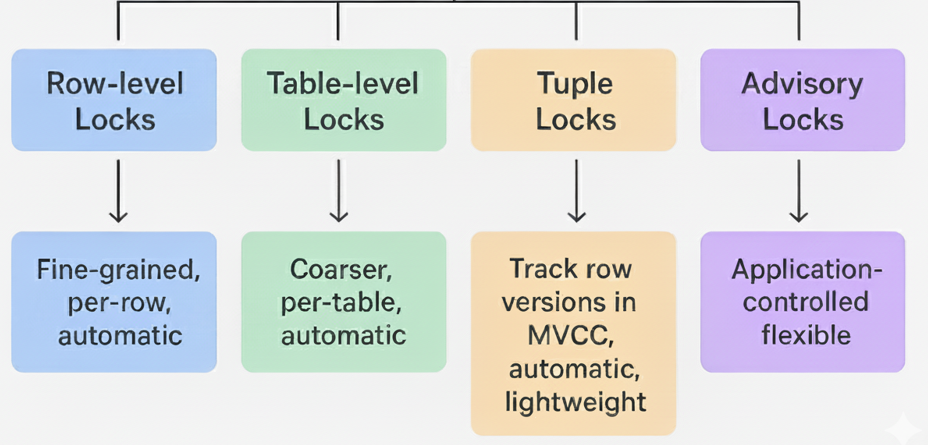
Row-level Locks
Row-level locks are applied automatically during operations such as SELECT … FOR UPDATE, UPDATE, and DELETE.
They protect individual rows while allowing other rows in the same table to be accessed concurrently.
| Lock Type | Description |
|---|---|
FOR UPDATE |
Locks selected rows for update. Other transactions cannot modify them until the current transaction commits. |
FOR NO KEY UPDATE |
Similar to FOR UPDATE, but allows changing non-key columns. |
FOR SHARE |
Locks selected rows for reading. Other transactions can also read but cannot modify them. |
FOR KEY SHARE |
Prevents updates or deletions to a row’s key while allowing other non-conflicting changes. |
Key detail: Row-level locks are lightweight and automatically released at the end of the transaction.
Table-level Locks
Table-level locks control access to entire tables. They are coarser than row-level locks and are automatically acquired by certain SQL commands.
| Lock Type | Description |
|---|---|
ACCESS SHARE |
Acquired by SELECT. Allows multiple transactions to read simultaneously. |
ROW SHARE |
Acquired by SELECT … FOR UPDATE or SELECT … FOR SHARE. Prevents schema changes. |
ROW EXCLUSIVE |
Acquired by INSERT, UPDATE, DELETE. May conflict with other row-exclusive operations. |
SHARE UPDATE EXCLUSIVE |
Rare; allows reads but prevents concurrent schema changes. |
SHARE |
Acquired by CREATE INDEX. Blocks exclusive locks but allows reads. |
SHARE ROW EXCLUSIVE |
More restrictive; blocks most other operations except reads. |
EXCLUSIVE |
Blocks almost all other operations. |
ACCESS EXCLUSIVE |
The most restrictive; blocks reads, writes, and schema changes. |
Tip: PostgreSQL uses a lock compatibility matrix to determine which locks conflict. Understanding this matrix is helpful for debugging deadlocks and performance issues.
Tuple Locks (Row Version Locks)
Tuple locks protect individual row versions in PostgreSQL’s MVCC (Multi-Version Concurrency Control) system.
How it works:
- In PostgreSQL, every row can have multiple versions when updated concurrently.
- Tuple-level locks control which transaction can view or modify each version.
- These locks are automatic — you do not acquire them manually.
| Internal Lock | Purpose |
|---|---|
| Key-share lock | Prevents deletion of a tuple while allowing non-key updates. |
| Update lock | Ensures a tuple is not modified concurrently. |
| Exclusive lock | Applied when a tuple is being deleted or fully updated. |
Example scenario:
- Transaction A reads a row with
SELECT FOR UPDATE→ the tuple receives an update lock. - Transaction B tries to update the same row → it waits until Transaction A commits.
Key point: Tuple locks are part of row-level locking but specifically track row versions under MVCC. They are lighter and more granular than full row locks.
Advisory Locks
Advisory locks are user-defined and allow applications to coordinate actions across sessions. They do not interfere with MVCC row or table locks.
| Lock Function | Description |
|---|---|
pg_advisory_lock(bigint) |
Acquires an exclusive application-level lock on a 64-bit key. |
pg_advisory_xact_lock(bigint) |
Acquires an exclusive lock released automatically at transaction end. |
pg_advisory_unlock(bigint) |
Releases an exclusive advisory lock. |
pg_try_advisory_lock(bigint) |
Attempts to acquire the lock and returns immediately if unavailable. |
Note: All advisory lock functions can alternatively take two 32-bit integers instead of a single 64-bit key. This keeps tables clean while providing flexible locking mechanisms.
Other Internal Locks
PostgreSQL also uses internal locks to maintain system integrity, manage sequences, and protect caches.
| Lock Type | Description |
|---|---|
LWLock (Lightweight Lock) |
Protects shared internal structures. |
BufferPin |
Prevents buffer pages from being evicted while in use. |
TupleLock |
Protects tuple visibility in MVCC. |
Deadlock Detection Lock |
Used internally to detect circular wait conditions (deadlocks). |
Summary
- Row-level locks: fine-grained, per-row, automatic.
- Table-level locks: coarser, per-table, automatic.
- Tuple locks: track row versions in MVCC, automatic, lightweight.
- Advisory locks: application-controlled, flexible.
- Internal locks: maintain system integrity; not controlled by users.
Understanding PostgreSQL locks is essential for writing safe and high-performance applications. By choosing the right lock type and knowing how PostgreSQL manages concurrency, you can prevent deadlocks, optimize performance, and ensure data consistency.