Spring Data JPA projections
Author Ter-Petrosyan Hakob
- Overview
- Project setup
- Create entities
- Create repositories
- Interface Based Projections
- Class Based Projections
- Dynamic Projections
- Tuple projection
- Map @Query result to a dto
- Conclusion
Overview
Spring JPA gives us the ability via repository easy work with our data. The repository returns all data in entity representation, sometimes we don’t need all data, in this case, we can use projections.
Project setup
For demo purposes let’s create a simple project:
plugins {
    id 'org.springframework.boot' version '2.6.7'
    id 'io.spring.dependency-management' version '1.0.11.RELEASE'
    id 'java'
}

group = 'com.htp'
version = '0.0.1'
sourceCompatibility = '17'

repositories {
    mavenCentral()
}

dependencies {
    implementation 'org.springframework.boot:spring-boot-starter-data-jpa'
    runtimeOnly 'com.h2database:h2'
    testImplementation 'org.springframework.boot:spring-boot-starter-test'
}

tasks.named('test') {
    useJUnitPlatform()
}
Create entities
To make things simple let’s create three simple entities
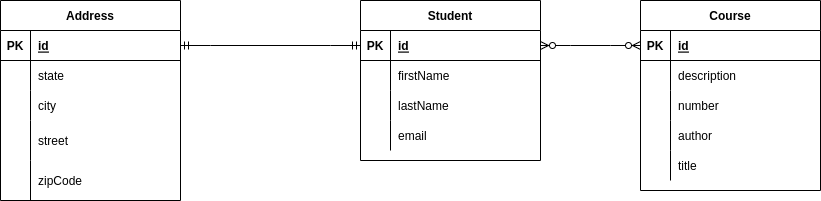
Student entity
@Entity
public class Student {

    @Id
    @GeneratedValue(strategy = GenerationType.SEQUENCE)
    private Long id;

    private String firstName;
    private String lastName;
    private String email;

    @ManyToMany(mappedBy = "students", fetch = FetchType.EAGER)
    public List<Course> courses = new ArrayList<>();

    @OneToOne(mappedBy = "student")
    private Address address;

    // getters and setters
}
Course entity
@Entity
public class Course {

    @Id
    @GeneratedValue(strategy = GenerationType.SEQUENCE)
    private Long id;

    private String title;
    private String description;
    private Integer number;
    private String author;

    @ManyToMany(cascade = {
            CascadeType.PERSIST,
            CascadeType.MERGE
    })
    @JoinTable(
            name = "student_course",
            joinColumns = @JoinColumn(name = "course_id", referencedColumnName = "id"),
            inverseJoinColumns = @JoinColumn(name = "student_id", referencedColumnName = "id")
    )
    private List<Student> students = new ArrayList<>();

    // getters and setters

}
Address entity
@Entity
public class Address {

    @Id
    @GeneratedValue(strategy = GenerationType.SEQUENCE)
    private Long id;

    @OneToOne
    private Student student;

    private String state;

    private String city;

    private String street;

    private String zipCode;

    //getters and setters
}
Create repositories
Let’s create repositories for our entities.
Student repository
public interface StudentRepository extends JpaRepository<Student, Long> {
}
Course repository
public interface CourseRepository extends JpaRepository<Course, Long> {
}
Address repository
public interface AddressRepository extends JpaRepository<Address, Long> {
}
Interface Based Projections
In this case, we create an interface with only getter methods of the properties we want from the entity class. This interface will be the return type of the query method we write in the repository.
Close Projection
In Close Projection, the getter methods of the interface match exactly with the getter methods of the Entity’s properties.
Let’s declare a projection interface for the Course and Student entities as shown below.
Course view
public interface CourseView {

    String getTitle();

    Integer getNumber();

    String getAuthor();
}
public interface CurseAuthorStudentView {

    String getTitle();

    Integer getNumber();

    List<CourseStudentView> getStudents();

    interface CourseStudentView {

        String getFirstName();

        String getEmail();
    }
}
Let’s add two methods to our course repository
public interface CourseRepository extends JpaRepository<Course, Long> {

    Optional<CourseView> getByNumber(Integer number);

    List<CurseAuthorStudentView> getByAuthor(String author);
}
Student View
public interface StudentView {

    String getEmail();

    String getFirstName();

    StudentAddressView getAddress();

    List<StudentCourseView> getCourses();

    interface StudentCourseView {
        String getTitle();

        Integer getNumber();

    }

    interface StudentAddressView {

        String getZipCode();
    }
}
public interface StudentRepository extends JpaRepository<Student, Long> {

    Optional<StudentView> getByEmail(String email);
}
Ok let’s summarize in the CourseRepository we have a getByNumber method which should return a CourseView and a getByAuthor which should return a CurseAuthorStudentView.
In the StudentRepository we have a getByEmail mehtod which should return a StudentView.
Let’s write some tests for our repository
test application.properties
jdbc.driverClassName=org.h2.Driver
jdbc.url=jdbc:h2:mem:myDb;DB_CLOSE_DELAY=-1

hibernate.dialect=org.hibernate.dialect.H2Dialect
hibernate.hbm2ddl.auto=create

spring.jpa.properties.hibernate.show_sql=true
spring.jpa.properties.hibernate.use_sql_comments=true
spring.jpa.properties.hibernate.format_sql=true

hibernate.cache.use_second_level_cache=false
hibernate.cache.use_query_cache=false
insert_data.sql
INSERT INTO student (id, email, first_name, last_name)
VALUES(1, 'gurgen@mail.com', 'Gurgen', 'Aloyan');

INSERT INTO address (id, student_id, state, city, street, zip_code)
VALUES(1, 1, 'AR', 'Armavir', 'Test', '00001');

INSERT INTO course (id, author, description, number, title)
VALUES(1, 'James Gosling', 'course description', 1, 'Java');

INSERT INTO student_course (course_id, student_id)
VALUES(1,1);
clean_up_data.sql
DELETE FROM address;
DELETE FROM student_course;
DELETE FROM course;
DELETE FROM student;
test for CourseRepository
@DataJpaTest
@Sql(scripts = "/insert_data.sql")
@Sql(scripts = "/clean_up_data.sql", executionPhase = AFTER_TEST_METHOD)
class CourseRepositoryTest {

    @Autowired
    private CourseRepository courseRepository;

    @Test
    void getByNumberTest() {
        var courseViewOptional = courseRepository.getByNumber(1);

        assertFalse(courseViewOptional.isEmpty());
        var courseView = courseViewOptional.get();

        assertEquals(courseView.getNumber(), 1);
        assertEquals(courseView.getTitle(), "Java");
        assertEquals(courseView.getAuthor(), "James Gosling");
    }

    @Test
    void getByAuthorTest() {
        var list = courseRepository.getByAuthor("James Gosling");

        assertFalse(list.isEmpty());
        assertEquals(list.size(), 1);

        var course = list.get(0);
        assertEquals(course.getNumber(), 1);
        assertEquals(course.getTitle(), "Java");

        var students = course.getStudents();
        assertFalse(students.isEmpty());
        assertEquals(students.size(), 1);

        var student = students.get(0);
        assertEquals(student.getEmail(), "gurgen@mail.com");
        assertEquals(student.getFirstName(), "Gurgen");
    }
}
NOTE Spring creates a proxy instance of the projection interface for each entity object, and all calls to the proxy are forwarded to that object.
test for StudentRepository
@DataJpaTest
@Sql(scripts = "/insert_data.sql")
@Sql(scripts = "/clean_up_data.sql", executionPhase = AFTER_TEST_METHOD)
public class StudentRepositoryTest {

    @Autowired
    private StudentRepository studentRepository;

    @Test
    void getByEmailTest() {
        var studentViewOptional = studentRepository.getByEmail("gurgen@mail.com");

        assertFalse(studentViewOptional.isEmpty());

        var studentView = studentViewOptional.get();
        assertEquals(studentView.getEmail(), "gurgen@mail.com");
        assertEquals(studentView.getFirstName(), "Gurgen");

        assertNotNull(studentView.getAddress());
        assertEquals(studentView.getAddress().getZipCode(), "00001");

        var courses = studentView.getCourses();
        assertFalse(courses.isEmpty());
        assertEquals(courses.size(), 1);

        var course = courses.get(0);
        assertEquals(course.getTitle(), "Java");
        assertEquals(course.getNumber(), 1);
    }
}
Open Projection
Open projection enable us to define interface methods with unmatched names and with return values computed at runtime.
Let’s create a new view for Student
public interface StudentInfoView {

    @Value("#{target.firstName + ' ' + target.lastName}")
    String getFullName();

    String getEmail();


    AddressView getAddress();

    interface AddressView {
        @Value("#{target.state + '/' + target.city}")
        String getFullAddress();
    }
}
and add a new method to the StudentRepository
public interface StudentRepository extends JpaRepository<Student, Long> {

    //...

    StudentInfoView getByFirstName(String firstName);
}
test for getByFirstName method
@DataJpaTest
@Sql(scripts = "/insert_data.sql")
@Sql(scripts = "/clean_up_data.sql", executionPhase = AFTER_TEST_METHOD)
public class StudentRepositoryTest {

    @Autowired
    private StudentRepository studentRepository;

    //...

    @Test
    void getByFirstNameTest() {
        var studentInfoView = studentRepository.getByFirstName("Gurgen");
        assertEquals(studentInfoView.getEmail(), "gurgen@mail.com");
        assertEquals(studentInfoView.getFullName(), "Gurgen Aloyan");
        assertEquals(studentInfoView.getAddress().getFullAddress(), "AR/Armavir");
    }
}
NOTE Open projections have a drawback. Spring Data cannot optimize query execution as it doesn’t know in advance which properties will be used. Thus, we should only use open projections when closed projections aren’t capable of handling our requirements.
Class Based Projections
Instead of using proxies Spring Data creates from projection interfaces, we can define our own projection classes.
- Parameter names of the class constructor must match the properties of the root entity class
- Also, define equals and hashCode implementations; they allow for processing projection objects in a collection
let’s create AddressDto
public class AddressDto {
    private String city;
    private String street;

    public AddressDto(String city, String street) {
        this.city = city;
        this.street = street;
    }

    //getters, setters, equals and hashCode
}
and add a new method to the AddressRepository
public interface AddressRepository extends JpaRepository<Address, Long> {

    List<AddressDto> findByZipCode(String zipCode);
}
test for findByZipCode method
@DataJpaTest
@Sql(scripts = "/insert_data.sql")
@Sql(scripts = "/clean_up_data.sql", executionPhase = AFTER_TEST_METHOD)
public class AddressRepositoryTest {

    @Autowired
    private AddressRepository addressRepository;

    @Test
    void findByZipCodeTest() {
        var listOfAddress = addressRepository.findByZipCode("00001");

        assertFalse(listOfAddress.isEmpty());
        assertEquals(1, listOfAddress.size());
        var address = listOfAddress.get(0);

        assertEquals("Armavir", address.getCity());
        assertEquals("Armavir", address.getStreet());
    }
}
Dynamic Projections
For dynamic projections, we should declare method in the repository with a argument of type Class<T> where T is the return type.
Let’s create StudentDto
public class StudentDto {
    private Long id;
    private String firstName;
    private String email;

     public StudentDto(Long id, String firstName, String email) {
        this.id = id;
        this.firstName = firstName;
        this.email = email;
    }

    //getters, setters, equals and hashCode
}
and add a new method to studet repository
public interface StudentRepository extends JpaRepository<Student, Long> {

    <T> T findByFirstName(String firstName, Class<T> clazz);

    //...
}
test for findByFirstName method
@DataJpaTest
@Sql(scripts = "/insert_data.sql")
@Sql(scripts = "/clean_up_data.sql", executionPhase = AFTER_TEST_METHOD)
public class StudentRepositoryTest {

    //...

    @Test
    void findByFirstName() {
        var studentInfoView = studentRepository.findByFirstName("Gurgen", StudentInfoView.class);
        assertEquals(studentInfoView.getEmail(), "gurgen@mail.com");
        assertEquals(studentInfoView.getFullName(), "Gurgen Aloyan");
        assertEquals(studentInfoView.getAddress().getFullAddress(), "AR/Armavir");

        var studentView  = studentRepository.findByFirstName("Gurgen", StudentView.class);
        assertEquals(studentView.getEmail(), "gurgen@mail.com");
        assertEquals(studentView.getFirstName(), "Gurgen");

        assertNotNull(studentView.getAddress());
        assertEquals(studentView.getAddress().getZipCode(), "00001");

        var courses = studentView.getCourses();
        assertFalse(courses.isEmpty());
        assertEquals(courses.size(), 1);

        var course = courses.get(0);
        assertEquals(course.getTitle(), "Java");
        assertEquals(course.getNumber(), 1);

        var studentDto  = studentRepository.findByFirstName("Gurgen", StudentDto.class);
        assertEquals(1, studentDto.getId());
        assertEquals(studentView.getFirstName(), "Gurgen");
        assertEquals(studentView.getEmail(), "gurgen@mail.com");

    }
}
Tuple projection
Let’s create findStudentsEmailAndIdAndCityByZipCode method in the AddressRepository and map the SQL projection recording to a JPA Tuple container.
public interface AddressRepository extends JpaRepository<Address, Long> {

    //...

    @Query("SELECT a.student.id as studentId, a.student.email as email, a.city as city  " +
            "FROM Address a WHERE a.zipCode = :zipCode")
    List<javax.persistence.Tuple> findStudentsEmailAndIdAndCityByZipCode(@Param("zipCode") String zipCode);
}
And as usual: writing unit test.
@DataJpaTest
@Sql(scripts = "/insert_data.sql")
@Sql(scripts = "/clean_up_data.sql", executionPhase = AFTER_TEST_METHOD)
public class AddressRepositoryTest {

    //...

    @Test
    void findStudentsEmailAndIdAndCityByZipCode() {
        var tuples = addressRepository.findStudentsEmailAndIdAndCityByZipCode("00001");
        assertEquals(1, tuples.size());

        var tuple = tuples.get(0);
        assertEquals(1, tuple.get("studentId", Long.class));
        assertEquals("Armavir", tuple.get("city", String.class));
        assertEquals("gurgen@mail.com", tuple.get("email", String.class));
    }
}
Instead of the Tuple we can use a Map<String, Object> or Object[] as the return type. When you use the Object[] you should remember the selected order
Map @Query result to a dto
As you can see in the previous, we do type casting and it is not good and not safe, to avoid it we can use a Dto class. Let’s create StudentInfoDTO
public class StudentInfoDTO {
    private Long studentId;
    private String email;
    private String city;

    public StudentInfoDTO(Long studentId, String email, String city) {
        this.studentId = studentId;
        this.email = email;
        this.city = city;
    }

    //getters and setters

}
now let’s add a findStudentsInfoByZipCode method in the StudentRepository
public interface AddressRepository extends JpaRepository<Address, Long> {

    //...

    @Query("SELECT new com.hakobtp.blog.dto.StudentInfoDto(student.id, a.student.email,  a.city)" +
            "FROM Address a WHERE a.zipCode = :zipCode")
    List<StudentInfoDto> findStudentsInfoByZipCode(@Param("zipCode") String zipCode);
}
And as usual: writing unit test.
@DataJpaTest
@Sql(scripts = "/insert_data.sql")
@Sql(scripts = "/clean_up_data.sql", executionPhase = AFTER_TEST_METHOD)
public class AddressRepositoryTest {

    //...

    @Test
    void findStudentsInfoByZipCode() {
        var students = addressRepository.findStudentsInfoByZipCode("00001");
        assertEquals(1, students.size());

        var student = students.get(0);
        assertEquals(1, student.getStudentId());
        assertEquals("Armavir", student.getCity());
        assertEquals("gurgen@mail.com", student.getEmail());
    }
}
Instead of the StudentInfoDto Class we can use a Record.
Conclusion
The source code for this article is available over on GitHub.