Centralized Log Analysis
Centralized log analysis is a way to collect and study log messages from many microservices in one place. It solves some problems that happen when each microservice writes logs only on its own server.
The Problem
Usually, an application writes log messages to files on the same server where it runs. In a system with many microservices, each running on different servers, this can cause problems:
- How can you see what is happening in the system when each microservice keeps its logs separate?
- How can you know if a microservice has a problem and is writing error messages?
- If users report a problem, how can you find which microservice caused it?
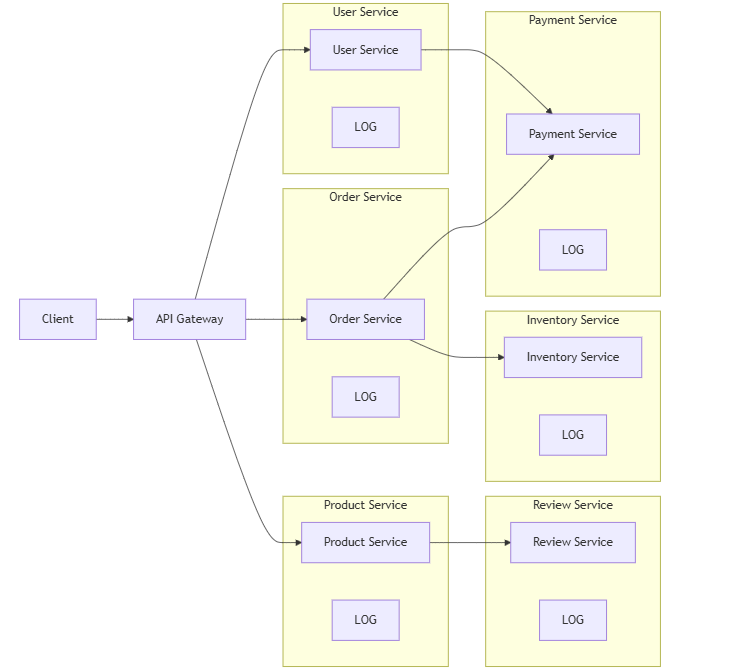
For example, imagine an online shop with these microservices:
- User Service – manages user accounts
- Order Service – handles customer orders
- Product Service – shows product information
- Payment Service – processes payments
- Inventory Service – tracks stock
- Review Service – manages product reviews
Each service writes logs on its own server. Finding a problem would be like searching for a needle in many haystacks.
Here is a simple diagram showing how services connect and where logs are stored:
The Solution
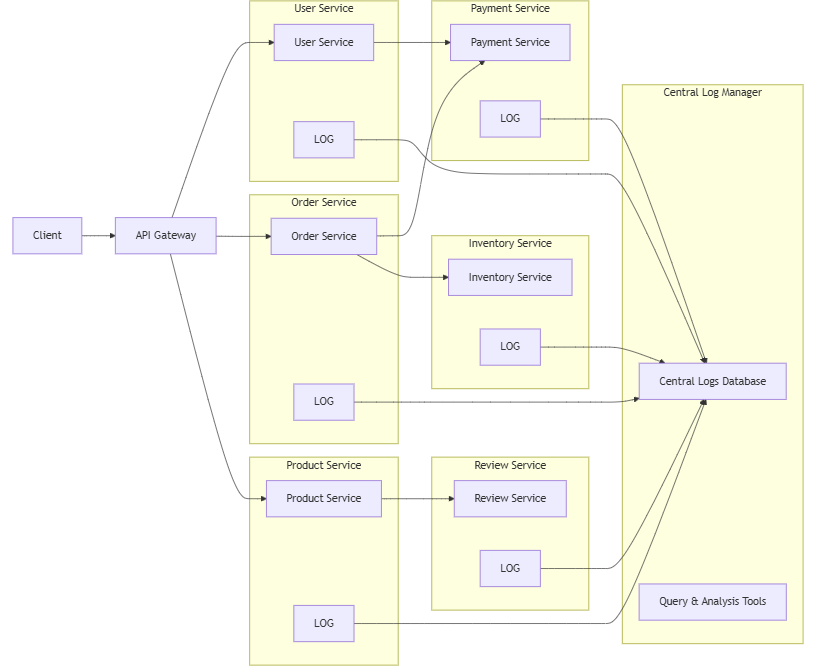
The solution is to add a central log manager. This component collects all logs in one place and helps you analyze them. A good log manager can:
- Detect new microservices and collect logs automatically
- Store logs in a structured and searchable format in a central database
- Provide tools or APIs to search and study logs
For example, if a payment service fails, the central log manager can quickly show all error messages from this service, making it easier to find the problem.
Solution Requirements
To make centralized logging work well, some rules are needed:
- Stream logs to standard output: Each microservice should send logs to stdout instead of writing them to separate files. This makes it easier for the log manager to find logs.
- Use correlation IDs: Tag logs with a unique ID for each request. This helps track one user request across many services.
- Use a common log format: All log messages should follow the same format. This makes it possible to store them in a database and search easily.
For example, a canonical log format could include:
- Timestamp (when the event happened)
- Service name (which microservice wrote the log)
- Severity (info, warning, error)
- Correlation ID (to track requests)
- Message (what happened)
With these rules, the central log manager can show all logs for one request, even if it touched multiple services.