Cross Join
Author Ter-Petrosyan Hakob
We can think of a join as a combination of rows from two or more tables.
For example, the following query returns all the combinations from the rows of the categories table and the rows of the goods table:
select
    c.id category_id,
    c.name category_name,
    g.id good_id,
    g.name good_name,
    g.price good_price
from categories c, goods g;

category_id | category_name | good_id |    good_name    | good_price
-------------+---------------+---------+-----------------+------------
           1 | Electronics   |       1 | Smartphone      |     699.00
           1 | Electronics   |       2 | Gaming Laptop   |    1200.00
           1 | Electronics   |       3 | Business Laptop |     800.00
           1 | Electronics   |       4 | Desktop PC      |     600.00
           1 | Electronics   |       5 | Refrigerator    |     500.00
           1 | Electronics   |       6 | Blender         |      80.00
           1 | Electronics   |       7 | Microwave       |     150.00
           2 | Computers     |       1 | Smartphone      |     699.00
           2 | Computers     |       2 | Gaming Laptop   |    1200.00
           2 | Computers     |       3 | Business Laptop |     800.00
           2 | Computers     |       4 | Desktop PC      |     600.00
.....
(35 rows)
This query makes a Cartesian product of the two tables. In other words, it pairs every row from categories with every row from goods.
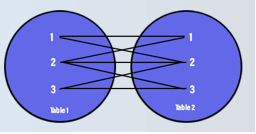
You can write the same query using the explicit CROSS JOIN syntax:
select
    c.id category_id,
    c.name category_name,
    g.id good_id,
    g.name good_name,
    g.price good_price
from categories c CROSS JOIN goods g;
Disadvantages of a CROSS JOIN
- Huge Result Sets
- If table A has
mrows and table B hasnrows, a CROSS JOIN returns \(m \times n\) rows. - Even small tables can produce millions of rows, which is often too many to handle.
- If table A has
- Slow Performance
- Generating every combination takes time.
- Your database must read all rows from both tables and write all combinations, using lots of
CPUand diskI/O.
- High Memory and Storage Use
- Temporary space may fill up if the result set is very large.
- Queries can fail or slow down other operations on the server.
- Meaningless Data
- Most combinations are not useful, since you usually want only related rows.
- It can confuse readers of your code, as they might expect a join condition to filter rows.
- Rarely Needed in Practice
- CROSS JOIN is mostly used for special cases (like generating test data or calendars).
- For real reports, INNER or OUTER joins are almost always more appropriate.
Only use CROSS JOIN when you really need every possible match. Otherwise, choose a join that filters rows, such as INNER JOIN or LEFT JOIN, to keep your result set clear and efficient.