Inner Join
Author Ter-Petrosyan Hakob
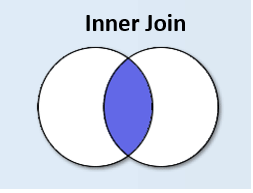
Suppose you start with all possible combinations of rows from the categories and goods tables
(a cross‑join). To filter that down to only matching category assignments
(i.e. categories.id = goods.category_id), use an INNER JOIN.
Implicit Join (Comma Syntax)
To achieve this, we need to run the following code:
select
    c.id category_id,
    c.name category_name,
    g.id good_id,
    g.name good_name,
    g.price good_price
from categories c, goods g where c.id = g.category_id;

 category_id | category_name | good_id |    good_name    | good_price
-------------+---------------+---------+-----------------+------------
           1 | Electronics   |       1 | Smartphone      |     699.00
           3 | Laptops       |       2 | Gaming Laptop   |    1200.00
           3 | Laptops       |       3 | Business Laptop |     800.00
           2 | Computers     |       4 | Desktop PC      |     600.00
           5 | Kitchen       |       5 | Refrigerator    |     500.00
           5 | Kitchen       |       6 | Blender         |      80.00
           5 | Kitchen       |       7 | Microwave       |     150.00
(7 rows)
Explicit INNER JOIN
We can also write the same query using the explicit JOIN operation:
select
    c.id    category_id,
    c.name  category_name,
    g.id    good_id,
    g.name  good_name,
    g.price good_price
from categories c
         inner join goods g on c.id = g.category_id;

 category_id | category_name | good_id |    good_name    | good_price
-------------+---------------+---------+-----------------+------------
           1 | Electronics   |       1 | Smartphone      |     699.00
           3 | Laptops       |       2 | Gaming Laptop   |    1200.00
           3 | Laptops       |       3 | Business Laptop |     800.00
           2 | Computers     |       4 | Desktop PC      |     600.00
           5 | Kitchen       |       5 | Refrigerator    |     500.00
           5 | Kitchen       |       6 | Blender         |      80.00
           5 | Kitchen       |       7 | Microwave       |     150.00
(7 rows)
This produces the same result but uses the ANSI‑standard JOIN syntax, which is generally clearer and preferred in modern SQL.
Filtering a Specific Category
If we wanted to search for all goods that belong to the Kitchen category using the INNER JOIN condition,
we would have to rewrite the query in this way:
select
    c.id    category_id,
    c.name  category_name,
    g.id    good_id,
    g.name  good_name,
    g.price good_price
from categories c
         inner join goods g on c.id = g.category_id
where c.name = 'Kitchen';

 category_id | category_name | good_id |  good_name   | good_price
-------------+---------------+---------+--------------+------------
           5 | Kitchen       |       5 | Refrigerator |     500.00
           5 | Kitchen       |       6 | Blender      |      80.00
           5 | Kitchen       |       7 | Microwave    |     150.00
(3 rows)
Why use JOIN over IN/EXISTS?
You can often express the same filtering logic with IN or EXISTS, but explicit JOIN is typically more readable and, in many database engines, can offer better performance by allowing the optimizer to plan more efficient execution paths.