Self Join
Author Ter-Petrosyan Hakob
A SELF JOIN is a regular JOIN where a table is joined to itself. You use table aliases so you can distinguish “two copies” of
the same table—one acting as the “left” side and one as the “right” side of the join.
SELECT * from categories;

id |    name     | parent_id
----+-------------+-----------
  1 | Electronics |    <null>
  2 | Computers   |         1
  3 | Laptops     |         2
  4 | Home        |    <null>
  5 | Kitchen     |         4
(5 rows)
To show each category with its parent name, join the categories table to itself:
SELECT
  child.id         AS category_id,
  child.name       AS category_name,
  parent.id        AS parent_id,
  parent.name      AS parent_name
FROM categories AS child
JOIN categories AS parent
  ON child.parent_id = parent.id;

 category_id | category_name | parent_id | parent_name
-------------+---------------+-----------+-------------
           2 | Computers     |         1 | Electronics
           3 | Laptops       |         2 | Computers
           5 | Kitchen       |         4 | Home
(3 rows)
- How It Works:
- Aliases: We refer to two logical copies of categories as child and parent.
- Join Condition:
child.parent_id = parent.idlinks each row in the“child”copy to its corresponding row in the“parent”copy. - Result: Only categories that have a
non‑NULLparent_idappear, because JOIN defaults to aninner join.
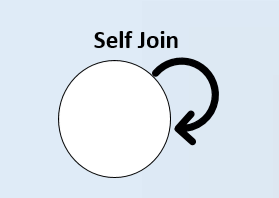
This diagram gives us an idea of how a self join works:
To list only the top‑level categories (those without a parent), you can use a LEFT JOIN and filter for NULL parents:
SELECT
    c.id   AS category_id,
    c.name AS category_name
FROM categories AS c
         LEFT JOIN categories AS p ON c.parent_id = p.id
WHERE p.id IS NULL;

 category_id | category_name
-------------+---------------
           1 | Electronics
           4 | Home
(2 rows)