Right Join
Author Ter-Petrosyan Hakob
The right join is the twin of the left join, so we would have the same result if we wrote table A left join table B ,
or table B right join table A . For example, we can obtain the same results if we write:
select c.id   AS category_id,
       c.name AS category_name,
       g.id   AS good_id,
       g.name AS good_name
from categories c
         left join goods g on g.category_id = c.id;

 category_id | category_name | good_id |    good_name
-------------+---------------+---------+-----------------
           1 | Electronics   |       1 | Smartphone
           3 | Laptops       |       2 | Gaming Laptop
           3 | Laptops       |       3 | Business Laptop
           2 | Computers     |       4 | Desktop PC
           5 | Kitchen       |       5 | Refrigerator
           5 | Kitchen       |       6 | Blender
           5 | Kitchen       |       7 | Microwave
           4 | Home          |  <null> | <null>
(8 rows)
or if we write:
select c.id   AS category_id,
       c.name AS category_name,
       g.id   AS good_id,
       g.name AS good_name
from goods g
         right join categories c on c.id = g.category_id;

 category_id | category_name | good_id |    good_name
-------------+---------------+---------+-----------------
           1 | Electronics   |       1 | Smartphone
           3 | Laptops       |       2 | Gaming Laptop
           3 | Laptops       |       3 | Business Laptop
           2 | Computers     |       4 | Desktop PC
           5 | Kitchen       |       5 | Refrigerator
           5 | Kitchen       |       6 | Blender
           5 | Kitchen       |       7 | Microwave
           4 | Home          |  <null> | <null>
(8 rows)
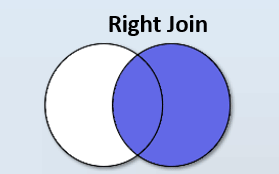
The RIGHT JOIN keyword returns all records from the right table (table2) and all records from the left table (table1) that match the right table (table2). The result is NULL from the left side when there is no match.
This diagram illustrates how RIGHT JOIN works: